
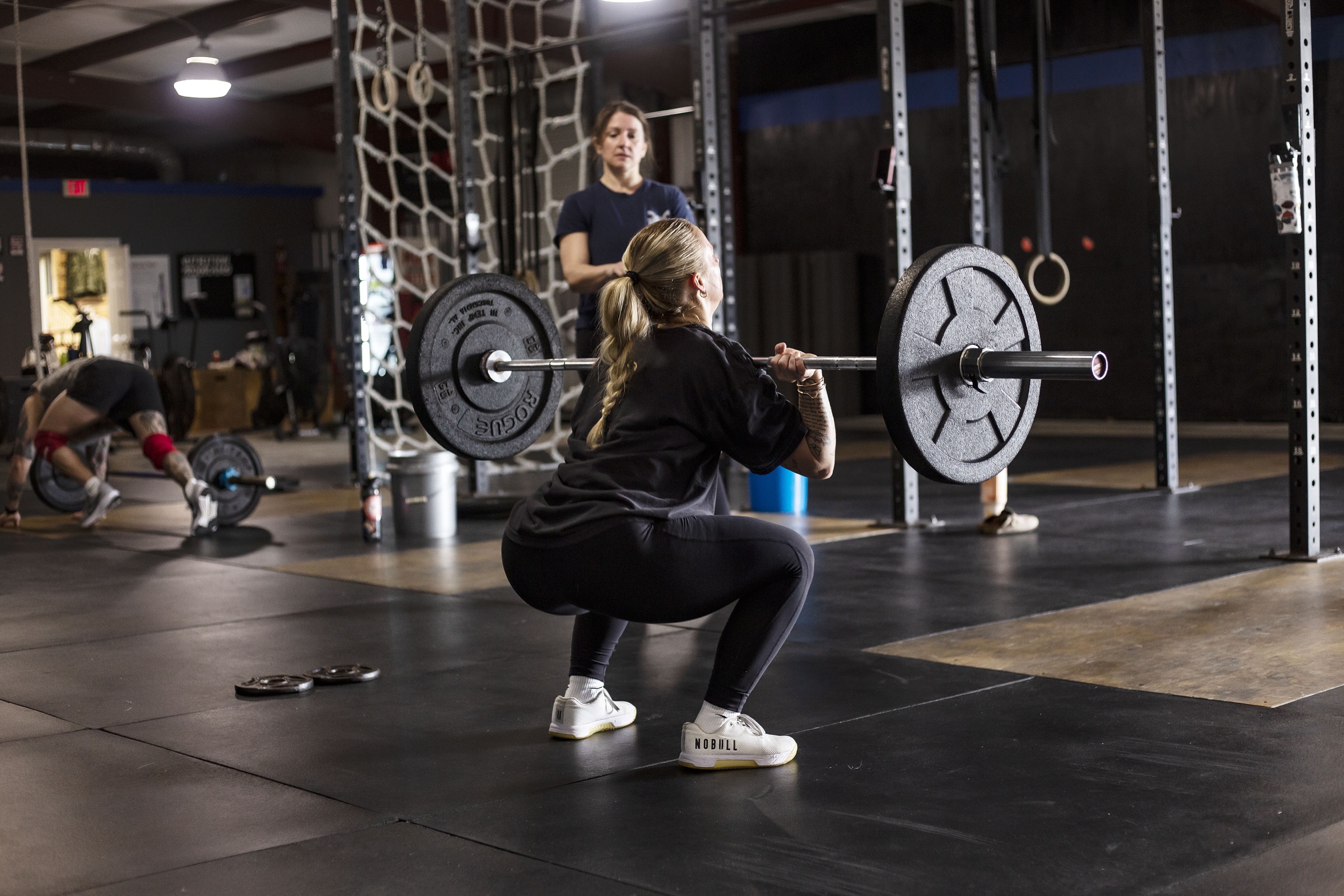
If you're taking Ozempic, Wegovy, Mounjaro or Zepbound, you need to lift weights. Studies find that roughly a third of the weight people lose on these drugs is lean mass, which includes muscle and other essential tissues, not fat. Strength training two to three days a week, plus enough protein, helps protect the lean mass you need to stay strong and healthy in your fat loss journey and as you age.
The shot can take the weight off. It can't make you strong enough to pick your kids up off the floor or carry all the groceries in one trip. That part is still yours to do.
Can you do CrossFit while you're on Ozempic or Zepbound?
Yes. Every workout at Bandit gets scaled to the person doing it, including weight, movement, and distance. Plenty of people walk into our gym in Woolmarket, just north of I-10 in Biloxi, having not lifted anything in years--or ever.
Here's what that looks like from the coaching side. If you let us know you're on a GLP-1, we'll ask whether you've eaten before class, because your appetite is low and 5 a.m. comes early. On a low-energy day, we lighten the weight instead of skipping the lift. And if you look lightheaded, we'll ask you to stop working out to keep you safe.
What we won't do is pretend the shot is a shortcut. If you're looking for a gym that will let you coast while the medicine does the work, we're not it. If you want to come out the other side of this stronger than you went in, you're in the right place.
How much muscle do you lose on a GLP-1?
More than most people expect. A 2025 review of nine clinical trials, led by Dr. Kristen Beavers at Wake Forest, found that lean mass made up about 31% of the weight people lost on GLP-1 drugs. Lose 30 pounds and around 9 of them weren't fat.
A 2026 analysis in the International Journal of Obesity pooled seven trials and found that people taking these drugs lost about 4 pounds more lean mass than people taking a placebo. In the semaglutide trials—the drug in Ozempic and Wegovy—that difference was about 12 pounds.
In fairness to the medicine, the same researchers pointed out that people lose far more fat than muscle, so their body composition still improves, and they don't think the muscle loss is a reason to avoid the drug. I agree. The drug isn't the problem. Doing nothing else while you're on it is.
Why does losing muscle matter if the scale is going down?
Because the scale can't tell you what you lost.
Muscle is what gets you up off the floor, up the stairs, and out of the car without grabbing the door frame. It's what keeps you on your feet when you trip in the yard. It's also what helps you keep weight off. When you lose muscle, you get lighter and weaker at the same time.
The other half of the problem is what happens when you stop. In the STEP 1 trial, researchers followed people for a year after they came off semaglutide. They'd regained about two-thirds of the weight they lost. Continuing to strength train helps you maintain the muscle you’ve built.
We say it our gym all the time: Comfort kills. A smaller body that can't carry its own groceries isn't the goal. A body that's hard to kill is.
What kind of exercise protects your muscle on a GLP-1?
Lifting. Walking is great, and you should keep doing it. But walking doesn't tell your body it needs to hold on to muscle. Picking up heavy things does.
A 2026 review in Metabolites on protecting muscle during GLP-1 treatment called structured resistance training one of the core pieces, alongside protein, and found that people who combined the drug with structured exercise did better at keeping the weight off.
What that looks like in real life:
- Two to three strength sessions a week. Squats, deadlifts, presses, pulls, carries. The same things you do in daily life, with weight on them.
- Load that gets heavier over time. If it never gets harder, your body has no reason to keep the muscle.
- Coaching on your form. Especially if you're new, or it's been a while since you lifted. Get hurt in week three and you're back to doing nothing.
That's what a CrossFit group class at Bandit is built around. If you'd rather start one-on-one, that's what personal training is for.
How much protein do you need on a GLP-1?
More than you're probably getting. The drug kills your appetite, which is the point. The trouble is protein goes out the window along with everything else.
The Metabolites review recommends around 1.2 to 1.5 grams of protein per kilogram of body weight per day during active weight loss, spread across your meals. In the real-world data it looked at, GLP-1 users were averaging about 77 grams a day, below that range for most adults.
For a 200-pound person, that's roughly 110 to 135 grams a day. Where to start:
- Eat the protein first. When you only have room for a few bites, make them count.
- Aim for 30 to 40 grams per meal rather than trying to catch up at supper.
- Keep easy options in the fridge. Greek yogurt, eggs, cottage cheese, leftover chicken, a protein shake when you can't face food.
This is where most people get stuck, and it's exactly what our nutrition coaching helps with. It's not a meal plan handed across a desk. It's a coach helping you work out what you'll actually eat when the medicine has you feeling full at 10 a.m.
Talk to your prescribing doctor before changing your diet or starting a new training program, especially if you have kidney problems or other health conditions.
Frequently Asked Questions
Do you lose muscle on semaglutide?
Yes, some. Clinical trials show an average loss of several pounds of lean mass, and lean mass makes up roughly a third of the total weight lost across GLP-1 studies. Strength training and eating enough protein are the two best ways to reduce it.
Is it safe to lift weights on a GLP-1?
For most people, yes. Strength training is one of the main things experts recommend for protecting muscle during GLP-1 treatment. Start with coaching, eat before you train, drink plenty of water, and check with your prescriber first if you have other health conditions.
How many days a week should I strength train on a GLP-1?
Two to three days a week is a good target for most adults, with the weight going up gradually over time. Consistency matters more than intensity when you're getting started.
What happens to my muscle if I stop taking a GLP-1?
Trial data shows most people regain a large share of the weight after they stop. Continuing to strength train helps you maintain the muscle you’ve built, which is why it’s worth building while you’re on the medicine.
The shot is a tool. So is a barbell. Only one of them makes you harder to kill.
If you're on a GLP-1 anywhere on the Mississippi Gulf Coast, this is exactly what we coach. Talk to a coach about building strength while you're on it. Twenty minutes, no pressure, and you'll leave knowing exactly where to start.
Janice M. Ferguson is the owner of Bandit CrossFit in Woolmarket, where she has coached since 2013. She is a CrossFit Level 3 Trainer and a Healthy Steps Nutrition coach.
Sources: Beavers et al., Obesity, 2025 · International Journal of Obesity, 2026 · Metabolites, 2026 · STEP 1 trial extension, Wilding et al., 2022


